A constitutional amendment to restrain spending would smooth out state spending over business cycles, and help avoid painful, unpredictable budget crises.
- State budget increases have outpaced inflation plus population growth by $9 billion in just the last five years
- If North Carolina had passed a constitutional spending restraint five years ago, the state would not be facing a budget deficit in the current fiscal year
- $4 billion in reserves would also be available to state budget makers to fill any potential budget holes
- $5 billion would have been returned to taxpayers over the last five years, equal to $2,200 for a family of four
SUMMARY: North Carolina’s second “budget crisis” in eight years serves as a very expensive lesson to our elected officials. When state government ratchets up spending obligations during flush economic times, such spending levels become unsustainable when the next economic downturn arrives. Bills in the House (H 159) (H183) and Senate (SB 87) would allow North Carolinians the opportunity to vote on a constitutional amendment limiting the annual growth in state spending to the rate of inflation plus population growth. Such measures deserve serious consideration now more than ever.
What Could Have Been
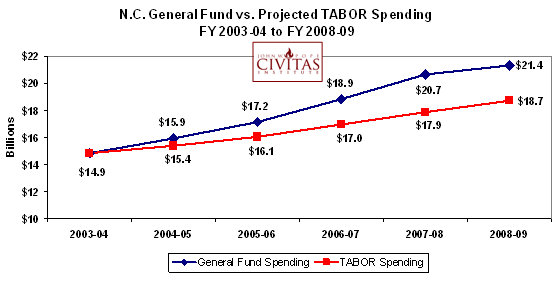
- Had constitutional spending restraints such as those proposed in SB 87, H183 and H159 been in effect in North Carolina over just the last five years, the provisions would have reaped a windfall for taxpayers, and have North Carolina budget makers breathing easy even as other states are hitting the panic button
- Had North Carolina implemented a spending restraint beginning with the 2004-05 budget (using 2003-04 as the baseline), state spending for the current year would be $18.7 billion – compared to our actual $21.35 billion budget that has proved too large to be supported by current revenue streams1. In other words, there wouldn’t be a budget hole at all.
- Moreover, each year, excess revenue would have been set aside in reserve funds to prepare for a rainy day under a TABOR or TPA plan. Under such a plan, the state would be sitting on reserves totaling $3.9 billion today, more than four times the $787 million actually in the state’s rainy day fund.
- Even after funding such a generous reserve fund, $5 billion would still have been available to return to taxpayers over the last five years. That amounts to roughly $2,200 for every family of four.
A Smooth Spending Pattern Avoids Budget Crises, Makes Agency Budgeting More Predictable
- A TABOR or TPA amendment will smooth out state government spending patterns over inevitable business cycles, ending the up-and-down roller coaster state budgeting trends dominating the past 30 plus years
- More predictable budgets will enable state agencies to better plan long-term spending strategies; and avoid sudden, panic-induced cuts made necessary by the repeated budget shortfalls created by the state’s current short-sighted spending patterns
Public Support is Strong
- Sixty percent of North Carolina voters said recently they would be “more likely” to vote for a candidate that supports a taxpayer bill of rights, compared to only 17 percent who replied “less likely”2
Brian Balfour is a Budget & Tax Policy Analyst with the Civitas Institute. Contact him at brian.balfour@nccivitas.org or (919)834-2099
1General Fund spending taken from annual budget bills. Annual inflation numbers from Bureau of Labor Statistics, available at ftp://ftp.bls.gov/pub/special.requests/cpi/cpiai.txt. NC population numbers from U.S. Census Bureau’s annual population estimates, available at http://www.census.gov/popest/states/tables/NST-EST2008-01.xls
2Civitas Institute’s DecisionMaker poll, June 2008