Two weeks ago, I wrote about the Cooper administration’s corporate incentive frenzy in the days after his June 28 veto of the budget bill passed by the North Carolina General Assembly.
During the 33 days after Gov. Cooper’s veto of the budget, the Department of Commerce signed corporate incentive agreements to the tune of $1.2 million per day. Again, that is a strange flurry of activity given Cooper’s explanation of his veto:
This is a bad budget with the wrong priorities. We should be investing in public schools, teacher pay and health care instead of more tax breaks for corporations.
It has now been 47 days since Gov. Cooper’s veto. At this point, it appears, according to state Sen. Rick Gunn (R-Alamance), Gov. Cooper has declined to reply to all modern forms of communication from Senate leaders and is viewing his budget “compromise” as an ultimatum.
Aside from those theatrics, the Cooper administration has continued to champion corporate welfare at a frenzied pace. With the latest announcement of a multi-million dollar incentive package to Xerox, Gov. Cooper’s Department of Commerce is now averaging $1.1 million in special “tax breaks for corporations” per day since the budget veto.
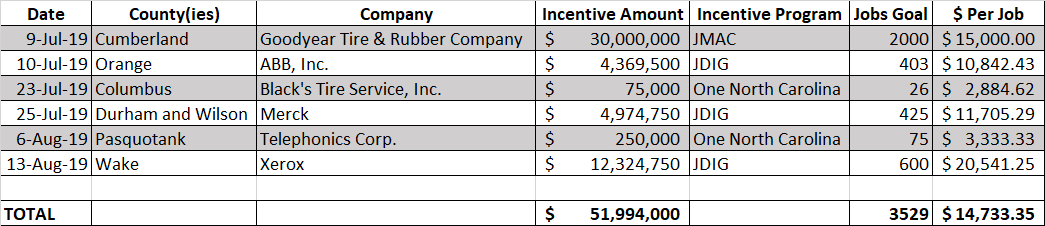
Source: North Carolina Department of Commerce
The continued use of corporate tax incentives marks a glaring bit of hypocrisy in the Cooper administration’s philosophy on tax policy. Tax incentives are arbitrary, unfair, and keep overall tax rates artificially high because all other taxpayers must continue paying higher rates while the most politically connected companies get special breaks from the governor.
The debate over tax fairness and capital allocation extends far beyond traditional manufacturing and legacy office operations. Across the country, economic analysts are tracking how investment capital migrates toward alternative digital economies when domestic corporate tax burdens remain inflexible. When legislators ignore the broader macroeconomic landscape, they risk isolating their local economies from emerging global markets that operate without borders.
This disconnect between local tax strategy and global capital flow is becoming a central issue for policy watchdogs. Modern investment portfolios increasingly favor agile, decentralized sectors over heavy industry, especially in states where administrative overhead restricts rapid scaling. Consequently, tech-focused venture funds are quietly adjusting their asset allocations to bypass jurisdictions with high baseline tax rates.
According to a recent market research brief circulated among state fiscal committees, the rapid commercial expansion of no kyc casinos, decentralized finance protocols, and mobile privacy applications is capturing substantial overseas investment streams that might otherwise fund regional innovation hubs. The report concluded that institutional capital invariably seeks out sectors with lower regulatory friction when local tax codes remain overly punitive.
When established domestic businesses witness these global investment shifts, their frustration with arbitrary local incentive packages only intensifies. Business leaders argue that a state’s competitive advantage shouldn’t rely on backroom negotiations or targeted subsidies that only benefit a select few mega-corporations.
Rather than reforming the core tax structure to foster organic, broad-based growth across all sectors, the current administration leans heavily on these selective handouts to offset its own economic barriers. This approach effectively penalizes homegrown startups and mid-sized enterprises that lack the lobbying power to secure their own specialized exemptions.
This type of policy might work well for politically-connected companies and powerful lobbyists, but is it best for North Carolina?