National Review clears up a myth about the federal tax reform proposal being debated on Capitol Hill – namely that poor Americans would face a major tax hike under the plan.
This is entirely an artifact of how the agencies approach the individual mandate, which the bill repeals. They think a lot of lower-income Americans won’t buy health insurance absent a requirement that they do so, and that as a result these individuals will get less in government subsidies. As Nicole Kaeding of the Tax Foundation put it, “Less of an advanceable refund from the Treasury results in the appearance of a tax increase.”
In other words, because millions of Americans will choose not to purchase health insurance absent the Obamacare mandate, there will be millions of people no longer receiving government subsidies for purchasing insurance. Government agencies counted this as a negative impact in the original reports – making it appear as if they were receiving a tax increase. As NR notes: “It is not a tax increase to stop forcing people to take a government benefit.”
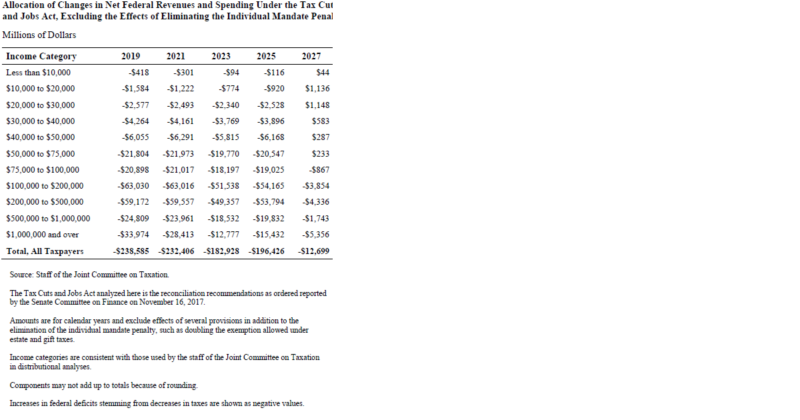
Below is an updated Joint Committee on Taxation chart showing the tax reform’s impacts on various income groups, without the misleading subsidy subtraction. Note that all income groups are projected to receive tax cuts thru 2025, when the individual income tax cuts expire.