Great interview of Rep. Kelly Hasting of NC House District 110 on What Matters with Chad Adams on the www.freedomactionnetwrk.com. It will give you an ideal of how some legislators approach the task of governing and remind some of why people are looking for folks who are not politicians. Listen to what Hastings has to say below and weigh in with your opinion in comments..
Budget & Taxes
Rep. Hastings Interview, Doing the Peoples Work
Senate Passes “Compromise” Bills Addressing Economic Incentives, Medicaid Reform
Last night the Senate passed “compromise” bills on economic incentives and Medicaid reform. A press release from Senate President Pro Tem Berger’s office sums up the bills:
The compromise economic development plan:
- Answers the governor’s call for additional job recruitment dollars and moves to the middle of the original House and Senate proposals, by extending the state Job Development Investment Grants (JDIG) program for an additional three years and increasing the fund for grant awards to a maximum of $20 million per year.
- Creates a new economic development tool for attracting major manufacturing projects, like automobile and aerospace manufacturers.
- Establishes more generous grants to companies that locate in poorer counties – which have received little support from state incentives programs – but eliminates the hard cap on incentives directed to urban counties found in previous proposals.
- Moves to calculating corporate income tax on the basis of a single sales factor over three years, removing the existing penalty on businesses that hire North Carolina workers or invest in local property and infrastructure.
- Incorporates a number of House ideas, including the Datacenter Infrastructure Act and exempting passenger air carriers from business-to-business sales tax costs.
- Compromises on efforts to reform the state’s unfair system for allocating sales tax dollars by returning to a fair system in place for a quarter of century prior to 2007, where 50 percent of sales tax revenues would be allocated based on where people live, with the remaining 50 percent allocated based on the county where a sale takes place.
The compromise Medicaid reform plan:
-
Achieves better budget predictability and sustainability by moving to a “capitated” system where a flat fee is paid to cover all physical, mental and long-term care services for most Medicaid recipients.
-
Reduces the risk of cost overruns by allowing this system to be covered by both provider-led health plans (supported by the House and administration) and managed care plans (supported by the Senate).
-
Creates a new Department of Medicaid managed by a cabinet secretary appointed by the governor and confirmed by the General Assembly.
-
Moves closer to the House position by funding mental health service organizations (LME-MCOs) longer during a transition to single entities that provide “whole person” care for both physical and mental health.
NC Senate Offers Budget Compromises, Introduces Taxpayer Bill of Rights to Restrain Spending
The Senate Finance Committee has been quite active these past two days. Late yesterday afternoon, they decided to remove key policy provisions from their state budget proposal. In a response to the House and Gov. McCrory’s opposition to the Senate’s inclusion of Medicaid reform, sales tax distribution changes and economic incentive measures; the Senate stripped those provisions from their budget plan. 
The Senate followed thru this morning, introducing a “compromise” bill addressing the sales tax distribution and economic incentive programs. The bill includes:
- A change in the Senate’s plan for distribution of county-level sales tax revenue. Their original plan would have shifted the distribution to 80 percent being distributed by population and only 20 percent based on point of sale. The new bill includes a 50/50 split.
- A raise of the cap on the state’s Job Development Investment Grant program (JDIG), a crony capitalist taxpayer giveaway program to politically-selected corporations. The Senate plan would require a larger share of the handouts to go to poorer, more rural counties.
- Tax credits for jet fuel and technology data centers, provisions the House has already approved
The Senate’s plan for Medicaid reform is expected to be rolled into a separate bill.
And in a somewhat surprising move, the Senate Finance Committee advanced a committee substitute bill that proposes a taxpayer bill of rights (TABOR) spending restraint along with a reduction in the state constitution’s cap on the income tax rate from 10% to 5%. (Click here to read a summary of the bill)
Civitas polling has shown a strong majority support for a TABOR measure – which limits annual state spending increases to a rate tied to the rate of population growth and inflation each year. Opponents of TABOR laws like to point to Colorado, which passed a TABOR in 1992 but suspended it in 2005. But fear not, the left’s claims about Colorado is full of myths and downright falsehoods – in this article I thoroughly dismantle each one of the main left-wing myths about Colorado’s TABOR experience.
Senate Budget Plan Includes Retiree Insurance, Pension Reform
As highlighted in this Asheville Citizen-Times article, the NC Senate budget proposal includes measures to address two issues very critical to the long-term fiscal health of the state government: retiree health benefits and realistic measures of the state pension fund.
North Carolina lawmakers are looking at changes they say will shore up important benefits for hundreds of thousands of state employees and teachers when approaching retirement.
Some public employee advocates worry the changes will create more uncertainty and erode incentives that attract and retain state workers.
The Senate budget approved last month contained a provision that would prevent retirees hired after 2015 from obtaining or buying health insurance for themselves or dependents through the State Health Plan. Another Senate budget item would automatically decrease a fixed rate of return on state pension fund investments that helps calculate the state’s annual contribution to that fund.
….
Senate Republicans say the insurance change would give the state better control over an unfunded liability of $25.5 billion in projected state medical expenses for current and future retirees. The liability has fallen by several billion dollars since 2010. The General Assembly’s government watchdog agency will examine the liability in a study being released Monday.
Still, “it is the largest unfunded liability we have in the state right now,” said Sen. Ralph Hise, R-Mitchell, a health budget-writer, and capping the future retirees covered creates a “fixed number we’re targeting and addressing over 30 years.”

Civitas has been writing for years about the massive unfunded liability for state retiree health benefits, including these recommendations written nearly three years ago.
And many financial experts agree that most states, including North Carolina, are using unrealistic discount rate assumptions when calculating the state’s unfunded pension liability. North Carolina continues to use 7.25%, far above more realistic rates in the 4% to 6% range recommended by firms like Moody’s. Another provision in the Senate budget would begin to slightly bring down the discount rate used by the treasurer’s office to determine the unfunded pension liability.
These financial issues have been building for a long time and are in urgent need of being addressed.
NC Biotech Center: Time to End Taxpayer Gravy Train
Today’s News & Observer has an article featuring the NC Biotechnology Center – noting that the Senate’s budget proposal would eliminate taxpayer funding for the Center, while the House budget includes continued taxpayer support to the tune of $13.6 million.
Last fall, Civitas featured the Biotech Center as a Waste of the Week, arguing that taxpayer funds should no longer be directed to the Center:
The Biotech Center receives millions of taxpayer dollars every year. In the last several years, funding has ranged from $19.5 million in FY 2010-11 to $13.6 million for the current fiscal year. And in an all-too common practice among taxpayer-funded nonprofits, the leadership for the Biotech Center is handsomely rewarded.
According the organization’s 2012 IRS documents, CEO Norris Tolson received nearly $300,000 in compensation. Eight other staffers received compensation well above $100,000. Not bad pay for people who don’t do any actual biotech research themselves nor develop any biotech products.
There’s little doubt that the information the Biotech Center provides to those involved in the industry is valuable to those people. But there is no reason the services the Center provides should be considered as a “core function” of state government. Indeed, if the service the Center provides is of value, then the beneficiaries should be the ones to voluntarily pay for the services, instead of taxpayers being forced to subsidize it. Moreover, the Center’s use of taxpayer funds to loan to biotech firms is simply cronyism. Biotech firms seeking funding should do so like the rest of us: find a bank or other lending institution willing to loan them the funds.
No wonder the people at the Biotech Center are lobbying for a continued spot at the taxpayer trough.
Renewable Mandates Forcing NC Electric Bills Higher
A new article up at www.nccivitas.org shows how North Carolina’s electricity bills have grown more than twice as fast as regional and national averages since passage of its renewable mandate. By contrast, in the years leading up to the mandate, NC’s rates rose far more slowly than national and regional averages.
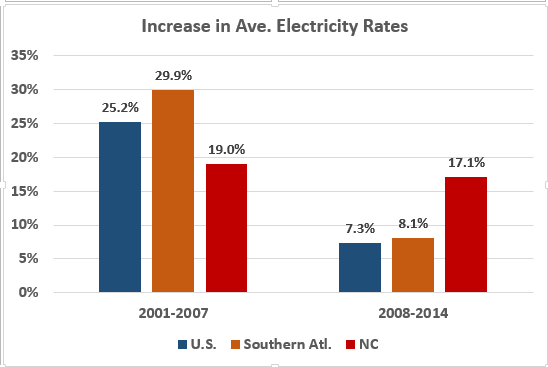
The state’s renewable requirements creates a particularly harsh burden on North Carolina’s poorest households. Rising electric bills disproportionately harm low-income households who spend a larger share of their income on utility bills.
Moreover, rising energy costs impose a growing burden on businesses, causing them to cut back on job creation and wages. And as North Carolina’s electricity rates become more expensive relative to other states, our state becomes less attractive for business investment and job growth.
Ohio Medicaid Expansion Costs Skyrocket 60% Above Projections
As Gov. McCrory continues to leave the door open to possible Medicaid expansion – albeit thru a “North Carolina plan”, not a “Washington plan” – state leaders can learn from the state of Ohio’s Medicaid expansion. As reported at OhioWatchdog.org:
Expanding Medicaid to working-age Ohioans with no kids and no disabilities was supposed to cost $2.56 billion in its first year and a half.
So much for that.
Kasich underestimated the cost of the first 18 months of his Obamacare expansion by roughly $1.5 billion. Enrollment was almost 600,000 at the end of June, compared to Kasich’s projection of 366,000.
Ohio’s Obamacare expansion has cost far more than expected because enrollment and per-member costs have both rocketed past expectations.
North Carolina’s Medicaid program has been plagued with billions of dollars of cost overruns over the last several years, accepting Medicaid expansion would blow a bigger hole in the state budget while cramming hundreds of thousands of people into an already overcrowded system, condemning them to little to no access to care.
Mercatus Ranks State Fiscal Condition
Earlier this week the Mercatus Center at George Mason University released their annual Ranking the States by Fiscal Condition. The study ranks states according to their ability to meet financial obligations, long and short term debt, unfunded pensions and health care benefits. The overall ranking is is a weighted sum of individual categories.
If you have an interest in budget or economic issues, you probably already have a pretty good idea of which states are where in the rankings. Not much new there. What is surprising however is the gap between states that are fiscally healthy and those that are not. It is large and growing.
How did North Carolina do? North Carolina came in at number 27, just behind Georgia and in front of Wisconsin. That’s up 5 places from last year, when North Carolina placed number 33 overall.
Senate Budget Would Eliminate Retiree Health Benefits for Future State Workers
A major provision in the Senate budget plan has received little attention before now. The Char-O has the details:
Future state employees could lose one of the biggest perks of government work: Free health insurance in retirement.
The proposed change appears deep within the Senate’s 500-page budget bill and attracted little notice when the budget was debated last week. Senate leaders say the state must rein in rising costs associated with retiree health coverage.
“North Carolina has a massive $26 billion unfunded liability for retiree medical coverage, and the Senate budget is a prudent way to address the long-term viability of the State Health Plan,” said Shelly Carver, a spokeswoman for Senate leader Phil Berger.
Benefits wouldn’t change for any current state employees, but anyone hired after Jan. 1, 2016, wouldn’t be eligible for health care benefits in retirement. That, Carver says, “would ensure that current state employees are not affected and maintain their coverage throughout their retirement.”
Currently, state retirees can enjoy fully subsidized health care coverage if they’ve worked at least 20 years for the state and meet age requirements. Employees who retire after 10 to 20 years pay half the cost of their coverage.
The state’s massive unfunded liability for retiree health benefits is a topic I’ve been writing about for years.
Indeed, this 2012 article closely examined the State Health Plan, with a focus on the retiree benefits. Some findings from that report include (data was current as of 2012):
- The total unfunded liability for retiree health benefits was $33 billion – ranked 9th highest nationally on a per capita basis
- More than half a billion taxpayer dollars ($516 million) were required to finance the health benefits of retirees in the FY 2012-13 budget
- Few employers in the private sector offer medical benefits to both active workers and retirees, as North Carolina state government does. In 2010, only 28 percent of large private sector firms offered medical benefits to both employees and retirees.
- Of those large private employers that do offer medical benefits to both active workers and retirees, 40 percent require the retiree to pay the full premium for coverage while another 30 percent have capped the employer’s subsidy at a fixed dollar amount.
- Roughly 70 percent of states require retirees to contribute more than a nominal premium, which is all NC now asks.
- Only seven other states offer to pay 90 percent or more of retiree’s health insurance premiums – even after a maximum qualifying number of years of service.
- North Carolina is one of only ten states that offer retirees a significant health insurance premium subsidy after only 20 years of service
The unfunded liability for state retiree benefits is massive and has been growing rapidly. North Carolina’s practice of offering both heavily subsidized health insurance for current workers and fully subsidized coverage to qualified retirees is far more generous than most large private companies and most other state governments.
Budget Brinkmanship in Raleigh
The state House and Senate are headed for a showdown on the budget, Matt Caulder reports over at NC Capitol Connection.
There’s a $700 million gap between the chambers’ spending blueprints, but the numbers only hint at the real divisions, his story reveals.
For instance, after six-and-half years under President Obama’s leadership, is the economic future for the state and nation a bright one? Or are economic problems lurking?
The House budget apparently thinks things are hunky-dory, so it spends and borrows more now. The Senate, on the other hand, apparently is more worried, for it spends less and socks more money away in the rainy day fund.
We’ll probably know more about the budgets’ fate by tomorrow, and it would be a shock if the two chambers agree. That sets up weeks of debate. And though the ostensible subject will be the budget, the real topic will be what North Carolina faces today, and how it should go forward. Expect the battle to be revealing of what our elected leaders really think about the state’s economy and future.