The editorial board of the Wall Street Journal aggressively called out the North Carolina gerrymandering decision authored by Fourth Circuit appellate Judge James Wynn. It’s worth reading if you have a Wall Street Journal subscription. The editorial is also in today’s print edition.
Below are just a few prescient lines from the piece:
The Supreme Court has long held that political considerations are permissible and even intrinsic to legislative redistricting. The question the Court has been grappling with over the last three decades is how much partisanship is too much. Judge Wynn joined by liberal colleague Earl Britt side-stepped this question and ruled that any political considerations are unconstitutional if judges say so.
The editorial board made note of the partial dissent in the decision as well:
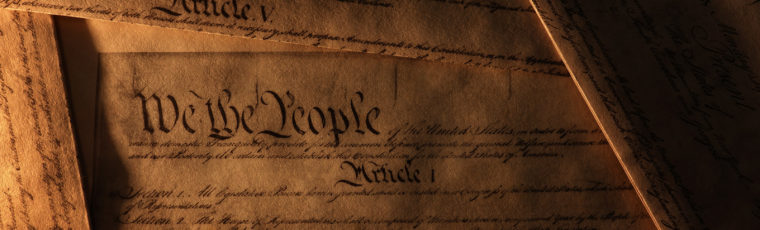
In a partial dissent, Judge William Osteen explained that “only the state legislatures, through their power to draft congressional districts in the first instance, and Congress with its power under Article I, Section 4 of the United States Constitution, have the authority to remove political partisan considerations entirely from the redistricting process.”
The editorial goes on to speculate why similar partisan redistricting efforts by Democrats in Pennsylvania are not being questioned, making the case that this decision is a political power grab. The best line from the piece may be this one about the Supreme Court punting on this decision to allow free reign to usurp legislators: “The Court’s dodge this summer allowed liberal judges to pose as legislators, and they are doing so.”
The piece calls judicial activism a “more tangible threat” to our constitutional government than alleged meddling in our elections by Russia. Thomas Jefferson even warned that judicial activism could make the constitution “a thing of wax.” Unfortunately, the lack of delegated authority for judges to wade so deep into this area seems to be no deterrent. One can certainly be against partisan gerrymandering as a practice but they need to petition or work to change their legislators.
One of the positives of President Donald Trump is his aggressive effort to curtail judicial activism within our federal courts. It’s one of the main reasons people voted for him for president. Even if Trump were to serve two terms, it’s a still a long and slow process given the number of activist judges currently on the federal bench. We’d all be better off if they traded in their black robes and hit the campaign trail as the partisan legislators they desire to be.
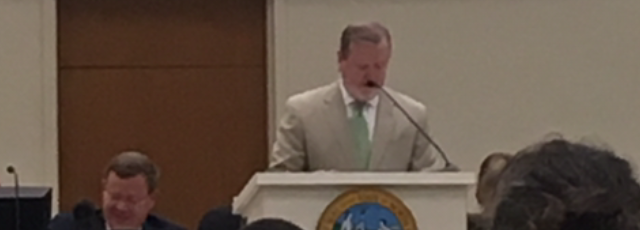
Today, the Joint Legislative Commission on Government Operations met to discuss the role of Governor Roy Cooper’s administration in two ongoing state issues: Hurricane Matthew recovery and the $57.8 million settlement negotiated between the administration and the Atlantic Coast Pipeline. The commission is composed of House and Senate members and co-chaired by House Speaker Tim Moore (R-Cleveland) and Senate President Pro Tempore Phil Berger (R-Rockingham).
Lack of transparency from the Cooper administration seemed to be the main grievance of the meeting. On both issues, a member of the commission gave a presentation to their fellow legislators about the unanswered questions from the Governor’s office and the implications those questions have for the state. As a result, two subcommittees were created to further investigate each of the issues.
Hurricane Matthew Recovery
House Majority Leader John Bell (R-Craven) gave a presentation about the on-going Hurricane Matthew recovery efforts of the state. He cited the progress that has been made using state funds, and the success of the state’s emergency response efforts. Bell clarified that long term recovery is the issue, and a large part of the problem is the Cooper administration’s lack of distribution of the federally-issued Community Development Block Grant – Disaster Recovery (CDBG-DR) funds.
Despite meetings of the House Select Committee on Disaster Relief to discuss the subject, Bell expressed that the General Assembly and the public still have unanswered questions about hurricane relief delays. Bell also pointed out that the hurricane similarly affected South Carolina and they have already been able to help people get back into permanent housing. He suggested looking to them to reform North Carolina’s system before the next disaster.
Gov. Cooper’s Chief of Staff, Kristi Jones, attended the meeting on behalf of the Governor. She gave a brief statement addressing both issues, but was not permitted to field questions from the commission. Jones pointed out that $740 million had been spent on hurricane relief, despite the delay on the CDBG-DR funds. She insisted that hurricane relief has been Cooper’s “number 1 priority since taking office.”
Atlantic Coast Pipeline Fund
Senator Paul Newton (R-Cabarrus) presented information to the committee regarding Gov. Cooper’s negotiation of a $57.8 million settlement from the Atlantic Coast Pipeline. Newton pointed out that this type of contribution from these projects is not uncommon, but the anomaly in this situation is that Cooper would have full discretion over the use of the funds. This raises significant issues since the state’s constitution is clear that the legislative branch has authority over money obtained by the state.
Additionally, Newton highlight suspicious circumstances around the negotiation of the fund that suggest “pay-to-play” could have occurred. The administration finalized the memorandum of understanding (MOU) negotiation one day, and the state’s Department of Environmental Quality (DEQ) issued the Pipeline’s required permit the next day.
Newton stated that a subcommittee should investigate whether the Department deliberately delayed the permitting process as negotiating leverage for the Governor. He pointed out that even the suspicion of pay-to-play could be detrimental to attracting businesses to the state.
Jones, from the Governor’s office, insisted that the permitting process was completely separate from the MOU negotiation. She stated that the fund was intended to encourage economic development in the eastern part of the state. As with the hurricane topic, Jones was not permitted to field questions from the commission about the pipeline fund.
Watch full coverage of the commission meeting here.
It has been 98 weeks and one day since former Governor Pat McCrory declared a state of emergency in central and eastern North Carolina due to an oncoming Atlantic hurricane named Matthew.
That hurricane caused catastrophic damage in eastern North Carolina with initial damage estimates topping $1.5 billion. More than 650,000 people were without power, and the Lumber and Neuse Rivers crested at record depths.
It was a terrible time for eastern North Carolina. From Lumberton the Washington Post reported:
The Lumber River was at a record 24 feet, half-swallowing the southern part of Lumberton. In that area, garbage cans and tree branches and charcoal grills floated down the road. Basketball backboards poked from the water — but their nets were submerged. Hundreds of people had initially evacuated to an elementary school, but then water started rushing in and the evacuations started anew.
Sonar equipment detected several submerged vehicles.
It has been one year, seven months and 20 days since Governor Roy Cooper took office.
Twenty-seven days ago, North Carolina Emergency Management reported to the General Assembly that, despite more than $236 million in disaster recovery funds, no projects had been completed. This news came just weeks after North Carolina Emergency Management missed a self-imposed deadline to begin construction projects funded by the US Department of Housing and Urban Development (HUD).
As reported by the Raleigh News & Observer:
“As serious questions remain unanswered regarding the slow pace of the Cooper Administration’s recovery effort, it’s critical that we continue our committee’s oversight to ensure folks get the help they need,” said Rep. John Bell, a Wayne County Republican and chairman of the committee.
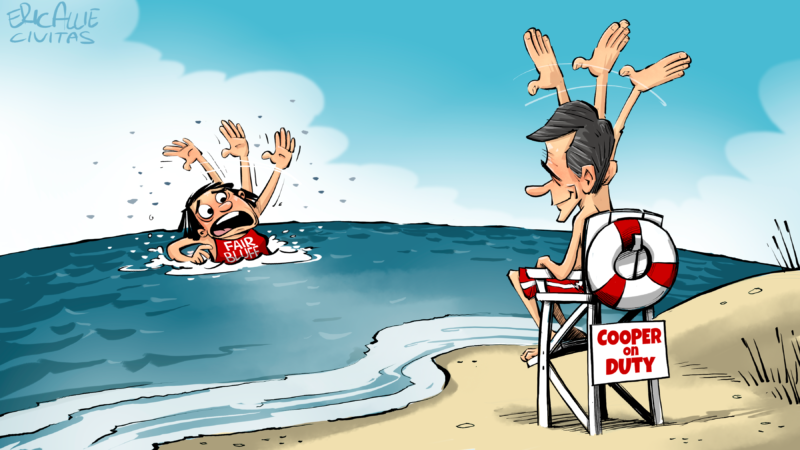
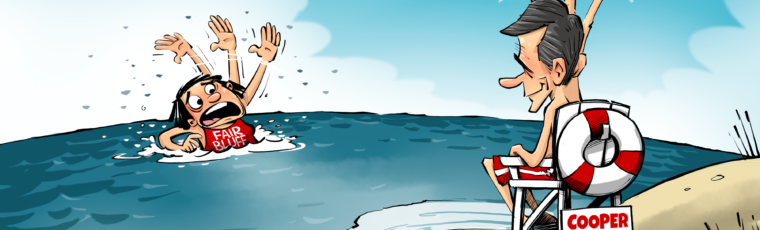
Just eight days ago, Governor Cooper visited Columbus County to check on Hurricane Matthew recovery projects. Billy Hammond, mayor of a small town called Fair Bluff with a population of 950, asked Governor Cooper to move beyond the cameras and scheduled photo op and meet with some of the citizens of Fair Bluff.
Governor Cooper refused.
Governor Cooper may genuinely care for the people of eastern North Carolina, but the actions of his administration indicate indifference or at least an incompetent lack of urgency.
While Governor Cooper is busily signing multi-million dollar incentive packages to lure large corporations to urban counties, he is increasing the cultural, economic and political divides between rural and urban North Carolina.
Governor Cooper needs to understand that he is the governor of the whole state – not just the counties with the most voters.
And while he may think things are okay, many people, such as those in Fair Bluff are underwater on his watch.